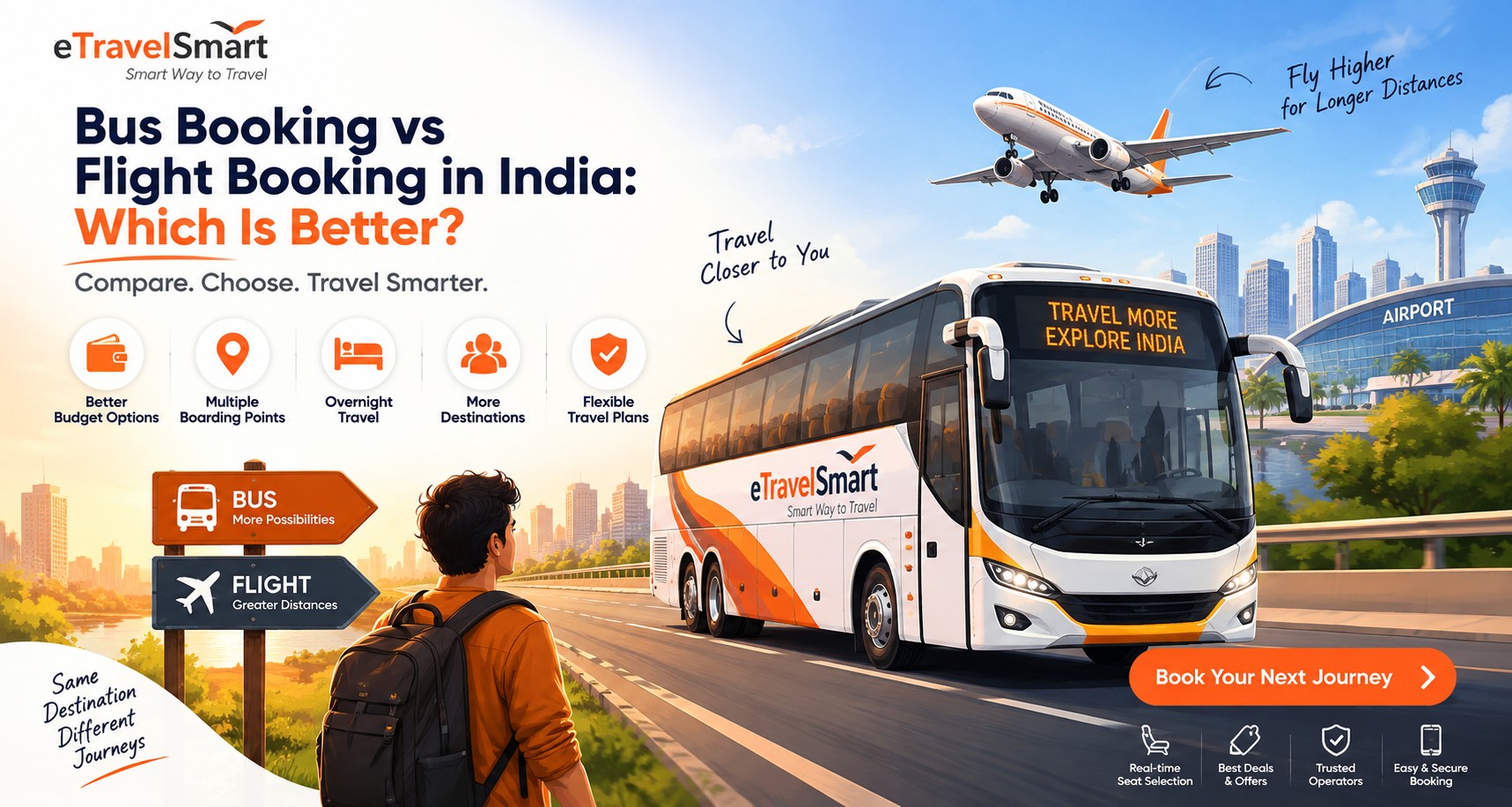
Bus booking vs flight booking in India: compare cost, convenience, sleeper buses, safety, routes, technology and the opportunities for travel OTAs.
Bus Booking vs Flight Booking in India: Why Buses Are a Major Opportunity for OTAs
When planning an intercity journey in India, travellers often compare bus tickets and flight tickets based on one question: Which one is faster?
But speed is only one part of a journey.
The actual travel experience also depends on the ticket price, distance to the airport or boarding point, check-in time, baggage, overnight travel options, comfort, arrival location and what happens when plans change.
For many short- and medium-distance journeys, bus travel can offer a practical alternative to flying. India’s intercity bus market has also evolved significantly, with premium AC coaches, sleeper buses, digital ticketing, GPS tracking and improved passenger facilities becoming increasingly common.
For online travel agencies (OTAs), this creates an opportunity that goes beyond simply selling bus tickets.
It opens the door to a large, fragmented transportation market that can be connected through technology, APIs, online payments, AI-powered search and personalised travel services.
How Big Is India’s Intercity Bus Market?
The scale of India’s bus market is one of the first things an OTA should understand.
According to the India BusTrack H2 FY26 report from redBus, covering October 2025 to March 2026, the estimated private intercity bus market recorded 147.19 million passenger journeys during the six-month period.
That works out to roughly 8.1 lakh passenger journeys per day on average.
The same report estimated:
- ₹14,216 crore in gross ticketing value
- 6,800+ active private bus operators
- 878,394 unique bus routes
- 12,551 towns connected
These figures demonstrate the scale and fragmentation of the private intercity bus ecosystem.
For an OTA, that fragmentation itself creates an opportunity: travellers can benefit from a platform that brings different operators, schedules, prices and seat types into one place.
Bus Booking vs Flight Booking: What Actually Matters to Travellers?
A flight is usually the obvious choice when travelling very long distances or when reaching the destination as quickly as possible is the priority.
However, for many domestic routes, travellers consider a much wider set of factors.
| Factor | Bus | Flight |
|---|---|---|
| Ticket price | Often more budget options | Generally higher |
| Boarding | Multiple city boarding points on many routes | Airport |
| Arrival | Often multiple city drop points | Airport |
| Overnight travel | Very common | Limited |
| Sleeper option | Available on many long-distance routes | No |
| Short/medium routes | Often practical | Depends on airport connectivity |
| Operator choice | Many private operators | Fewer airlines |
| Smaller cities/towns | Extensive road connectivity | Depends on airport availability |
| Booking comparison | Multiple bus operators can be compared | Multiple airlines can be compared |
Neither option is universally better.
The right choice depends on the route, travel purpose, budget and traveller’s priorities.
That distinction is important because the opportunity for an OTA is not to convince every passenger to replace flights with buses. It is to make it easier for travellers to choose the most suitable mode for their particular journey.
India’s aviation market also continues to handle a significant volume of domestic passengers. The Ministry of Civil Aviation publishes official information and statistics relating to India’s civil aviation sector.
1. City-to-City Travel Can Be Simpler by Bus
One of the biggest differences between bus and flight travel is the location of the boarding and arrival points.
An airport is usually located outside or away from the main residential and commercial areas of a city.
A bus operator may offer boarding points across the city.
For a passenger, the journey could look like:
Home → Nearby bus boarding point → Destination city → Nearby drop-off point
Instead of:
Home → Airport → Security/check-in → Flight → Destination airport → City → Final destination
The flight itself may be much faster, but the total door-to-door journey can involve considerably more steps.
This is especially relevant for travellers living far from airports.
2. Overnight Buses Can Save Valuable Daytime
Overnight Buses Can Save Valuable Daytime
Overnight travel is one of the biggest advantages of intercity bus travel. Instead of spending the daytime on the road, travellers can leave in the evening, sleep during the journey and reach their destination the following morning.
For example, someone travelling from Hyderabad to Bengaluru for a weekend trip or business meeting can choose an overnight sleeper service, depending on the available schedules and boarding points. Travellers can compare Hyderabad to Bangalore bus services based on departure time, bus type, sleeper availability, boarding location and fare.
This can be particularly useful for:
- Weekend travellers
- Working professionals
- Students
- People visiting family
- Short business trips
- Tourists
The advantage is not necessarily that the bus journey is faster than a flight. Instead, overnight bus travel allows passengers to use their sleeping hours for transportation, helping them arrive in the morning without giving up as much daytime for travel.
3. Sleeper Buses Have Changed the Bus Travel Experience
The traditional image of an intercity bus was often a basic seater coach.
That market has changed.
Travellers can now find different types of services depending on the route and operator, including:
- AC sleepers
- Non-AC sleepers
- Semi-sleepers
- Premium coaches
- Seater buses
- Hybrid configurations
The latest BusTrack data reported 52% of journeys as sleeper, 34% hybrid and 14% seater for its October 2025–March 2026 private intercity market dataset.
This indicates how important sleeper and hybrid services have become in modern intercity travel.
For passengers, the choice is no longer simply:
“Which bus goes there?”
It can be:
“Which bus gives me the comfort, timing and facilities I need?”
That creates an important opportunity for OTAs to provide better filtering and comparison.
4. Modern Bus Amenities Make Comparison More Important
A traveller booking a long-distance bus may want to know much more than the departure time.
Useful information can include:
- Sleeper or seater
- AC or non-AC
- Charging point
- Blankets
- Reading lights
- Curtains
- Wi-Fi where available
- Onboard toilet where available
- Rest-stop information
- GPS/live tracking
- Cancellation conditions
Not every bus offers every facility.
That is exactly why transparent information on an OTA becomes valuable.
Instead of making customers search individual operator websites or call operators, a booking platform can present the available features alongside the fare and schedule.
5. Safety Is Becoming a Technology Question
Safety should not be treated as a marketing claim that one mode of transportation is automatically safe.
Instead, travellers should look at the safety features and operating practices associated with the particular service.
Depending on the operator and vehicle, modern buses may use:
- GPS tracking
- Dashcams
- CCTV
- Driver monitoring
- Driver fatigue alerts
- Emergency exits
- Emergency hammers
- Fire extinguishers
- Speed monitoring
- Vehicle tracking systems
AI-assisted driver monitoring is also an emerging area where technology can help identify signs of driver fatigue or distraction.
For an OTA, displaying verified safety and vehicle information can help customers make better-informed booking decisions.
6. What About Onboard Toilets?
For long-distance passengers, access to a toilet can be an important booking factor.
Some premium or long-distance bus services provide onboard toilets, while other operators rely on scheduled rest stops.
Therefore, an OTA should not simply advertise “toilet buses.”
It should clearly show whether a specific service provides an onboard toilet.
The same principle can apply to other amenities.
Better information means better booking decisions.
7. Bus Tickets Can Offer More Price Choices
Price is one of the biggest factors in domestic travel.
Bus operators can offer a wide range of fares depending on:
- Route
- Date
- Bus type
- Seat type
- Demand
- Operator
- Booking period
- Season
This means travellers can often find several price points for the same city pair.
For a family or group travelling together, the difference in total transportation cost can become significant.
However, travellers should compare the total journey cost, not just the advertised ticket price.
For flights, this may include airport transfers, baggage and other optional charges. For buses, it may include local transportation to the boarding point.
8. Buses Connect More Cities and Towns
Air travel naturally depends on airport infrastructure.
Road transportation does not require an airport in every destination.
This allows bus networks to connect large cities with:
- Tier-2 cities
- Tier-3 cities
- Regional towns
- Tourist destinations
- Pilgrimage centres
- Industrial locations
For an OTA, this creates a much larger set of origin-destination combinations.
A customer might search:
Hyderabad → Bengaluru
But another customer may search:
Hyderabad → Kurnool
Warangal → Bengaluru
Bengaluru → Tirupati
Chennai → Madurai
Pune → Goa
The number of possible city combinations creates a substantial digital marketplace.
9. Why Is India’s Bus Market Attractive for OTAs?
The market’s fragmentation is one of its biggest characteristics.
Thousands of private operators serve different routes, cities and customer segments.
A traveller may otherwise need to check multiple operators individually.
An OTA can bring this information into one platform:
Search → Compare → Select → Pay → Receive Ticket → Track Journey
This is the basic value proposition of a transportation marketplace.
The latest BusTrack data’s estimate of more than 6,800 active private operators highlights the scale of the operator ecosystem.
10. A New OTA Doesn’t Need to Own Thousands of Buses
This is an important distinction between a bus operator and a bus OTA.
A bus operator needs vehicles, drivers, maintenance, permits, depots and operational infrastructure.
An OTA can focus on the technology and distribution layer.
It can connect with operators through:
- APIs
- Inventory integrations
- Operator dashboards
- Booking systems
- Payment gateways
The OTA can then focus on:
- Customer acquisition
- Search
- Booking experience
- Seat selection
- Payments
- Customer support
- Marketing
- AI-powered recommendations
- Corporate travel
This technology-led model can allow a startup to build a marketplace without owning the underlying bus fleet.
11. How Does a Bus OTA Make Money?
Commission is one potential revenue stream.
For example, suppose an OTA has:
Average ticket value: ₹1,000
Illustrative commission: 6%
The gross commission would be:
₹1,000 × 6% = ₹60
At 10,000 bookings:
10,000 × ₹60 = ₹6 lakh
At 50,000 bookings:
50,000 × ₹60 = ₹30 lakh
These are illustrative calculations only. Actual commissions vary according to operator agreements, distribution arrangements, route, platform and commercial terms.
An OTA can potentially generate additional revenue through:
- Service fees
- Advertising
- Corporate bookings
- Insurance
- Hotels
- Cabs
- Travel packages
- Other travel services
12. Bus Booking Can Be a Gateway to a Larger OTA
A customer may first discover an OTA because they need a bus ticket.
That does not mean the relationship has to end with the bus journey.
The same customer might later need:
Bus + Hotel
or
Flight + Hotel
or
Bus + Local Cab
or
Flight + Airport Transfer
or
Bus + Travel Insurance
This creates a larger customer lifetime opportunity.
For an OTA, the bus ticket can therefore be more than a transaction.
It can be the first interaction with a travel customer.
13. Why Bus Booking Can Help New Travel Startups Acquire Customers
Trust is important in online travel.
A customer may be reluctant to make a high-value booking on an unfamiliar platform.
A lower-value bus booking can provide a relatively accessible first transaction.
If the customer gets:
- Correct ticket
- Good operator
- Accurate boarding information
- Easy payment
- Reliable support
the platform can earn the opportunity for repeat business.
This doesn’t guarantee customer loyalty, but a positive first experience can help build trust.
14. AI Can Change How People Search for Buses
Traditional booking:
Enter From → Enter To → Date → Search → Filters → Select
The next generation of booking can be conversational.
For example:
“Find an AC sleeper from Hyderabad to Bengaluru tonight under ₹1,500, preferably near Kukatpally.”
An AI travel assistant could interpret:
- Destination
- Date
- Budget
- Bus type
- Boarding preference
- Amenities
and present suitable options.
This can make bus booking easier for customers who don’t know the names of operators or boarding points.
15. Personalisation Can Improve Repeat Booking
Frequent travellers often have predictable preferences.
Someone may regularly travel:
Hyderabad → Bengaluru every Friday
and prefer:
- AC sleeper
- Lower berth
- 9–11 PM departure
- Same boarding point
An OTA can use booking history to make future searches faster.
Features could include:
- Favourite routes
- Favourite operators
- Saved boarding points
- Price alerts
- Repeat booking
- Personalised recommendations
This can turn a one-time transaction into a repeat use travel platform.
16. Corporate Bus Booking Is Another Market
Bus booking is not limited to individual consumers.
Businesses may require transportation for:
- Employees
- Sales teams
- Factory workers
- Events
- Conferences
- Training programs
- Business trips
A corporate bus-booking platform could offer:
- Bulk bookings
- Employee profiles
- Centralised billing
- GST invoices
- Travel policies
- Approval workflows
- Booking reports
- Corporate credit arrangements
This gives an OTA a potential B2B market alongside B2C travel.
17. Tourism and Pilgrimage Create Additional Demand
Domestic travel creates another large use case for buses.
Travellers frequently use road transportation for:
- Religious trips
- Family visits
- Weekend holidays
- Weddings
- Festivals
- Tourist destinations
- Group travel
This also creates opportunities for route-specific content.
An OTA can provide useful pages such as:
- Hyderabad to Tirupati bus
- Hyderabad to Bengaluru bus
- Bengaluru to Chennai bus
- Hyderabad to Goa bus
- Chennai to Madurai bus
Each route can provide information about:
- Bus timings
- Fare ranges
- Operators
- Boarding points
- Dropping points
- Travel duration
- Sleeper options
- Amenities
18. Bus Travel Is Not a Replacement for Flights
This is an important part of an honest comparison.
Flights remain valuable when:
- The destination is very far away
- Time is the highest priority
- A direct flight is available
- The passenger needs to minimise travel time
- The bus journey would be excessively long
Buses can be particularly attractive when:
- The route is short or medium distance
- Overnight travel is convenient
- Budget matters
- City-centre boarding is useful
- Sleeper accommodation is preferred
- The destination has convenient road connectivity
The best travel platform should therefore help customers compare options rather than force them into one mode.
19. What Does the Future of Bus Booking Look Like?
The next generation of bus booking can combine transportation inventory with technology.
Imagine a platform where a traveller can:
- Ask an AI assistant for a route
- Compare operators
- Compare fares
- View actual boarding locations
- Select a sleeper or seater
- Check amenities
- Pay through UPI
- Receive a digital ticket
- Track the bus
- Get disruption notifications
- Book a hotel
- Arrange a local cab
- Rebook the return journey
The OTA then becomes more than a ticket seller.
It becomes a digital travel assistant.
Frequently Asked Questions
1.Is bus travel cheaper than flight travel in India?
Bus fares are often available at lower price points than flights, particularly on short and medium-distance routes. However, fares vary by route, operator, travel date, demand and bus type. Travellers should compare the total cost of the journey rather than only the ticket price.
2.Is bus travel better than flying in India?
There is no single answer for every journey. Flights are generally useful when travel time is the main priority, while buses can offer advantages such as lower-cost options, city boarding points and overnight sleeper services on suitable routes.
3.Why are sleeper buses popular in India?
Sleeper buses allow passengers to travel overnight while lying down, making them particularly useful for long-distance journeys. Premium sleeper services may also provide features such as AC, charging facilities, curtains and other amenities.
4.Are sleeper buses safe?
Safety depends on the individual operator, vehicle and journey. Travellers should check available safety information, operator reputation, emergency equipment, tracking features and booking-platform information before travelling.
5.Do buses have toilets in India?
Some long-distance and premium buses provide onboard toilets, while others rely on scheduled rest stops. Availability depends on the specific operator and service, so passengers should check the amenities listed for their particular bus before booking.
6.How many private bus operators are there in India?
The latest redBus BusTrack estimate for October 2025–March 2026 reported more than 6,800 active private bus operators in its private intercity bus market dataset.
7.How many people travel by private intercity buses in India?
The same BusTrack report estimated 147.19 million passenger journeys during October 2025–March 2026, equivalent to approximately 8.1 lakh journeys per day on average during that six-month period.
8.Can a startup start a bus-booking OTA without owning buses?
Yes. A bus OTA can aggregate inventory from existing operators through technology integrations and APIs rather than owning the vehicles itself. Its business can focus on distribution, customer acquisition, booking technology, payments and support.
9.How does a bus-booking OTA earn money?
Potential revenue sources include operator commissions, service fees, advertising, corporate bookings and cross-selling products such as hotels, cabs, insurance and travel packages. Commercial arrangements differ between platforms and operators.
10.Can AI improve online bus booking?
Yes. AI can help travellers search using natural language, compare options according to preferences, recommend suitable buses and personalise future searches based on previous bookings.
11.Why is bus booking an opportunity for OTAs?
India has a large and fragmented private intercity bus ecosystem with thousands of operators and a wide range of routes. An OTA can simplify this fragmented market by bringing inventory, schedules, fares, seats and amenities into a single digital platform.
Final Thoughts
For travellers, the choice between a bus and a flight should come down to the journey that fits their needs, not simply the speed of the vehicle.
For OTAs, however, the opportunity is broader.
India’s intercity bus market combines large passenger demand, thousands of operators, extensive road connectivity, multiple price points, sleeper services and increasing digitalisation.
Technology can make that market easier to navigate.
AI can make search more natural.
APIs can connect operator inventory.
Digital payments can simplify transactions.
GPS can improve journey visibility.
Better data can make amenities and boarding points clearer.
Corporate tools can open B2B demand.
And cross-selling can turn a bus booking into a broader travel relationship.
The opportunity isn’t simply to sell more bus tickets. It is to make intercity travel easier to discover, compare and book.
Recent Comments