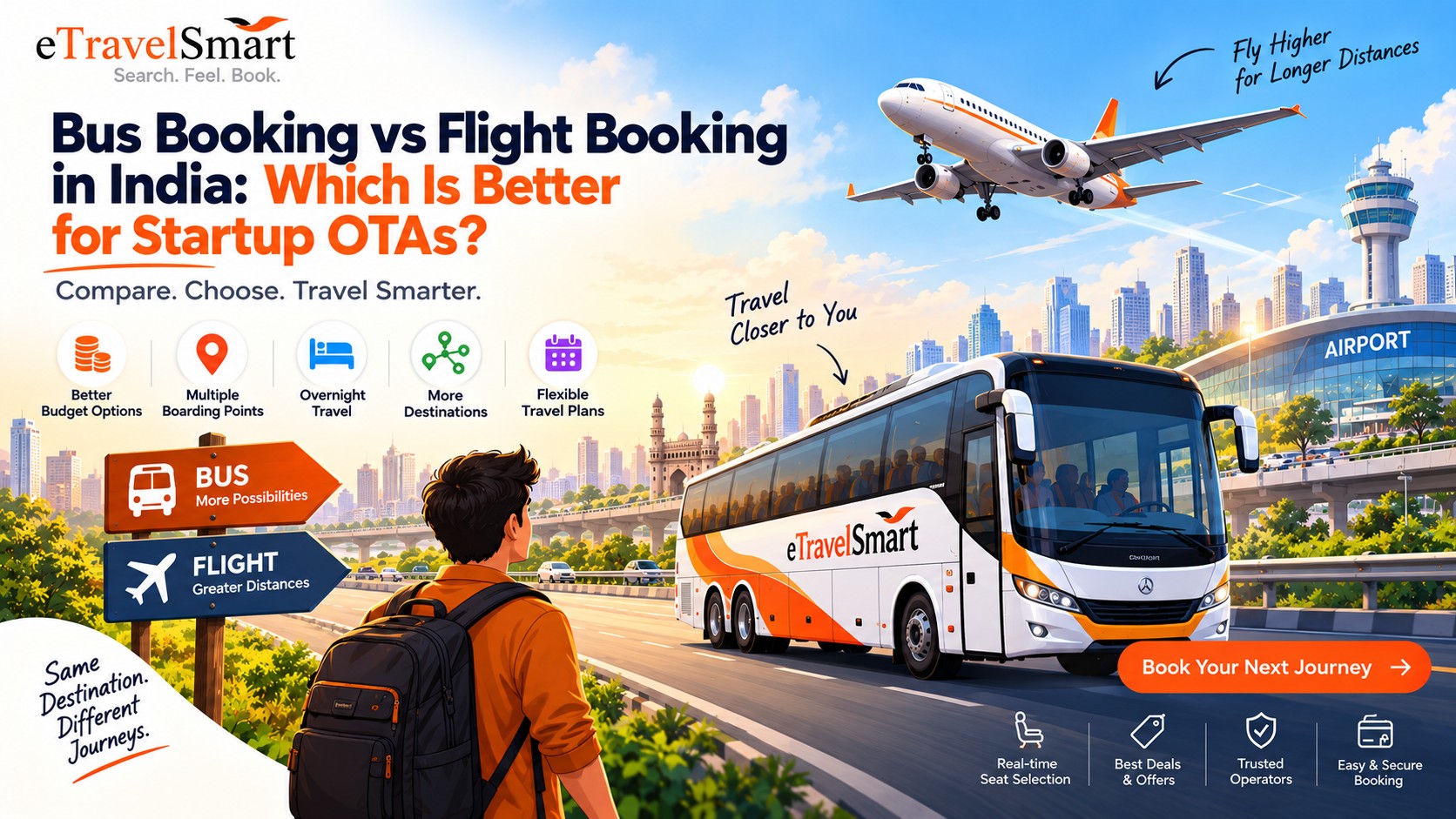
Bus Booking vs Flight Booking in India: Which Is Better For Startup OTAs?

Bus booking vs flight booking in India: compare cost, convenience, sleeper buses, safety, routes, technology and the opportunities for travel OTAs.

Bus Booking vs Flight Booking in India: Why Buses Are a Major Opportunity for OTAs

When planning an intercity journey in India, travellers often compare bus tickets and flight tickets based on one question: Which one is faster?

But speed is only one part of a journey.

The actual travel experience also depends on the ticket price, distance to the airport or boarding point, check-in time, baggage, overnight travel options, comfort, arrival location and what happens when plans change.

For many short- and medium-distance journeys, bus travel can offer a practical alternative to flying. India’s intercity bus market has also evolved significantly, with premium AC coaches, sleeper buses, digital ticketing, GPS tracking and improved passenger facilities becoming increasingly common.

For online travel agencies (OTAs), this creates an opportunity that goes beyond simply selling bus tickets.

It opens the door to a large, fragmented transportation market that can be connected through technology, APIs, online payments, AI-powered search and personalised travel services.

How Big Is India’s Intercity Bus Market?

The scale of India’s bus market is one of the first things an OTA should understand.

According to the India BusTrack H2 FY26 report from redBus, covering October 2025 to March 2026, the estimated private intercity bus market recorded 147.19 million passenger journeys during the six-month period.

That works out to roughly 8.1 lakh passenger journeys per day on average.

The same report estimated:

  • ₹14,216 crore in gross ticketing value
  • 6,800+ active private bus operators
  • 878,394 unique bus routes
  • 12,551 towns connected

These figures demonstrate the scale and fragmentation of the private intercity bus ecosystem.

For an OTA, that fragmentation itself creates an opportunity: travellers can benefit from a platform that brings different operators, schedules, prices and seat types into one place.

Bus Booking vs Flight Booking: What Actually Matters to Travellers?

A flight is usually the obvious choice when travelling very long distances or when reaching the destination as quickly as possible is the priority.

However, for many domestic routes, travellers consider a much wider set of factors.

FactorBusFlight
Ticket priceOften more budget optionsGenerally higher
BoardingMultiple city boarding points on many routesAirport
ArrivalOften multiple city drop pointsAirport
Overnight travelVery commonLimited
Sleeper optionAvailable on many long-distance routesNo
Short/medium routesOften practicalDepends on airport connectivity
Operator choiceMany private operatorsFewer airlines
Smaller cities/townsExtensive road connectivityDepends on airport availability
Booking comparisonMultiple bus operators can be comparedMultiple airlines can be compared

Neither option is universally better.

The right choice depends on the route, travel purpose, budget and traveller’s priorities.

That distinction is important because the opportunity for an OTA is not to convince every passenger to replace flights with buses. It is to make it easier for travellers to choose the most suitable mode for their particular journey.

India’s aviation market also continues to handle a significant volume of domestic passengers. The Ministry of Civil Aviation publishes official information and statistics relating to India’s civil aviation sector.

1. City-to-City Travel Can Be Simpler by Bus

One of the biggest differences between bus and flight travel is the location of the boarding and arrival points.

An airport is usually located outside or away from the main residential and commercial areas of a city.

A bus operator may offer boarding points across the city.

For a passenger, the journey could look like:

Home → Nearby bus boarding point → Destination city → Nearby drop-off point

Instead of:

Home → Airport → Security/check-in → Flight → Destination airport → City → Final destination

The flight itself may be much faster, but the total door-to-door journey can involve considerably more steps.

This is especially relevant for travellers living far from airports.

2. Overnight Buses Can Save Valuable Daytime

Overnight Buses Can Save Valuable Daytime

Overnight travel is one of the biggest advantages of intercity bus travel. Instead of spending the daytime on the road, travellers can leave in the evening, sleep during the journey and reach their destination the following morning.

For example, someone travelling from Hyderabad to Bengaluru for a weekend trip or business meeting can choose an overnight sleeper service, depending on the available schedules and boarding points. Travellers can compare Hyderabad to Bangalore bus services based on departure time, bus type, sleeper availability, boarding location and fare.

This can be particularly useful for:

  • Weekend travellers
  • Working professionals
  • Students
  • People visiting family
  • Short business trips
  • Tourists

The advantage is not necessarily that the bus journey is faster than a flight. Instead, overnight bus travel allows passengers to use their sleeping hours for transportation, helping them arrive in the morning without giving up as much daytime for travel.

3. Sleeper Buses Have Changed the Bus Travel Experience

The traditional image of an intercity bus was often a basic seater coach.

That market has changed.

Travellers can now find different types of services depending on the route and operator, including:

  • AC sleepers
  • Non-AC sleepers
  • Semi-sleepers
  • Premium coaches
  • Seater buses
  • Hybrid configurations

The latest BusTrack data reported 52% of journeys as sleeper, 34% hybrid and 14% seater for its October 2025–March 2026 private intercity market dataset.

This indicates how important sleeper and hybrid services have become in modern intercity travel.

For passengers, the choice is no longer simply:

“Which bus goes there?”

It can be:

“Which bus gives me the comfort, timing and facilities I need?”

That creates an important opportunity for OTAs to provide better filtering and comparison.

4. Modern Bus Amenities Make Comparison More Important

A traveller booking a long-distance bus may want to know much more than the departure time.

Useful information can include:

  • Sleeper or seater
  • AC or non-AC
  • Charging point
  • Blankets
  • Reading lights
  • Curtains
  • Wi-Fi where available
  • Onboard toilet where available
  • Rest-stop information
  • GPS/live tracking
  • Cancellation conditions

Not every bus offers every facility.

That is exactly why transparent information on an OTA becomes valuable.

Instead of making customers search individual operator websites or call operators, a booking platform can present the available features alongside the fare and schedule.

5. Safety Is Becoming a Technology Question

Safety should not be treated as a marketing claim that one mode of transportation is automatically safe.

Instead, travellers should look at the safety features and operating practices associated with the particular service.

Depending on the operator and vehicle, modern buses may use:

  • GPS tracking
  • Dashcams
  • CCTV
  • Driver monitoring
  • Driver fatigue alerts
  • Emergency exits
  • Emergency hammers
  • Fire extinguishers
  • Speed monitoring
  • Vehicle tracking systems

AI-assisted driver monitoring is also an emerging area where technology can help identify signs of driver fatigue or distraction.

For an OTA, displaying verified safety and vehicle information can help customers make better-informed booking decisions.

6. What About Onboard Toilets?

For long-distance passengers, access to a toilet can be an important booking factor.

Some premium or long-distance bus services provide onboard toilets, while other operators rely on scheduled rest stops.

Therefore, an OTA should not simply advertise “toilet buses.”

It should clearly show whether a specific service provides an onboard toilet.

The same principle can apply to other amenities.

Better information means better booking decisions.

7. Bus Tickets Can Offer More Price Choices

Price is one of the biggest factors in domestic travel.

Bus operators can offer a wide range of fares depending on:

  • Route
  • Date
  • Bus type
  • Seat type
  • Demand
  • Operator
  • Booking period
  • Season

This means travellers can often find several price points for the same city pair.

For a family or group travelling together, the difference in total transportation cost can become significant.

However, travellers should compare the total journey cost, not just the advertised ticket price.

For flights, this may include airport transfers, baggage and other optional charges. For buses, it may include local transportation to the boarding point.

8. Buses Connect More Cities and Towns

Air travel naturally depends on airport infrastructure.

Road transportation does not require an airport in every destination.

This allows bus networks to connect large cities with:

  • Tier-2 cities
  • Tier-3 cities
  • Regional towns
  • Tourist destinations
  • Pilgrimage centres
  • Industrial locations

For an OTA, this creates a much larger set of origin-destination combinations.

A customer might search:

Hyderabad → Bengaluru

But another customer may search:

Hyderabad → Kurnool

Warangal → Bengaluru

Bengaluru → Tirupati

Chennai → Madurai

Pune → Goa

The number of possible city combinations creates a substantial digital marketplace.

9. Why Is India’s Bus Market Attractive for OTAs?

The market’s fragmentation is one of its biggest characteristics.

Thousands of private operators serve different routes, cities and customer segments.

A traveller may otherwise need to check multiple operators individually.

An OTA can bring this information into one platform:

Search → Compare → Select → Pay → Receive Ticket → Track Journey

This is the basic value proposition of a transportation marketplace.

The latest BusTrack data’s estimate of more than 6,800 active private operators highlights the scale of the operator ecosystem.

10. A New OTA Doesn’t Need to Own Thousands of Buses

This is an important distinction between a bus operator and a bus OTA.

A bus operator needs vehicles, drivers, maintenance, permits, depots and operational infrastructure.

An OTA can focus on the technology and distribution layer.

It can connect with operators through:

  • APIs
  • Inventory integrations
  • Operator dashboards
  • Booking systems
  • Payment gateways

The OTA can then focus on:

  • Customer acquisition
  • Search
  • Booking experience
  • Seat selection
  • Payments
  • Customer support
  • Marketing
  • AI-powered recommendations
  • Corporate travel

This technology-led model can allow a startup to build a marketplace without owning the underlying bus fleet.

11. Bus Booking Can Be a Gateway to a Larger OTA

A customer may first discover an OTA because they need a bus ticket.

That does not mean the relationship has to end with the bus journey.

The same customer might later need:

Bus + Hotel

or

Flight + Hotel

or

Bus + Local Cab

or

Flight + Airport Transfer

or

Bus + Travel Insurance

This creates a larger customer lifetime opportunity.

For an OTA, the bus ticket can therefore be more than a transaction.

It can be the first interaction with a travel customer.

12. Why Bus Booking Can Help New Travel Startups Acquire Customers

Trust is important in online travel.

A customer may be reluctant to make a high-value booking on an unfamiliar platform.

A lower-value bus booking can provide a relatively accessible first transaction.

If the customer gets:

  • Correct ticket
  • Good operator
  • Accurate boarding information
  • Easy payment
  • Reliable support

the platform can earn the opportunity for repeat business.

This doesn’t guarantee customer loyalty, but a positive first experience can help build trust.

13. AI Can Change How People Search for Buses

Traditional booking:

Enter From → Enter To → Date → Search → Filters → Select

The next generation of booking can be conversational.

For example:

“Find an AC sleeper from Hyderabad to Bengaluru tonight under ₹1,500, preferably near Kukatpally.”

An AI travel assistant could interpret:

  • Destination
  • Date
  • Budget
  • Bus type
  • Boarding preference
  • Amenities

and present suitable options.

This can make bus booking easier for customers who don’t know the names of operators or boarding points.

14. Personalisation Can Improve Repeat Booking

Frequent travellers often have predictable preferences.

Someone may regularly travel:

Hyderabad → Bengaluru every Friday

and prefer:

  • AC sleeper
  • Lower berth
  • 9–11 PM departure
  • Same boarding point

An OTA can use booking history to make future searches faster.

Features could include:

  • Favourite routes
  • Favourite operators
  • Saved boarding points
  • Price alerts
  • Repeat booking
  • Personalised recommendations

This can turn a one-time transaction into a repeat use travel platform.

15. Corporate Bus Booking Is Another Market

Bus booking is not limited to individual consumers.

Businesses may require transportation for:

  • Employees
  • Sales teams
  • Factory workers
  • Events
  • Conferences
  • Training programs
  • Business trips

A corporate bus-booking platform could offer:

  • Bulk bookings
  • Employee profiles
  • Centralised billing
  • GST invoices
  • Travel policies
  • Approval workflows
  • Booking reports
  • Corporate credit arrangements

This gives an OTA a potential B2B market alongside B2C travel.

16. Tourism and Pilgrimage Create Additional Demand

Domestic travel creates another large use case for buses.

Travellers frequently use road transportation for:

  • Religious trips
  • Family visits
  • Weekend holidays
  • Weddings
  • Festivals
  • Tourist destinations
  • Group travel

This also creates opportunities for route-specific content.

An OTA can provide useful pages such as:

  • Hyderabad to Tirupati bus
  • Hyderabad to Bengaluru bus
  • Bengaluru to Chennai bus
  • Hyderabad to Goa bus
  • Chennai to Madurai bus

Each route can provide information about:

  • Bus timings
  • Fare ranges
  • Operators
  • Boarding points
  • Dropping points
  • Travel duration
  • Sleeper options
  • Amenities

17. Bus Travel Is Not a Replacement for Flights

This is an important part of an honest comparison.

Flights remain valuable when:

  • The destination is very far away
  • Time is the highest priority
  • A direct flight is available
  • The passenger needs to minimise travel time
  • The bus journey would be excessively long

Buses can be particularly attractive when:

  • The route is short or medium distance
  • Overnight travel is convenient
  • Budget matters
  • City-centre boarding is useful
  • Sleeper accommodation is preferred
  • The destination has convenient road connectivity

The best travel platform should therefore help customers compare options rather than force them into one mode.

18. What Does the Future of Bus Booking Look Like?

The next generation of bus booking can combine transportation inventory with technology.

Imagine a platform where a traveller can:

  1. Ask an AI assistant for a route
  2. Compare operators
  3. Compare fares
  4. View actual boarding locations
  5. Select a sleeper or seater
  6. Check amenities
  7. Pay through UPI
  8. Receive a digital ticket
  9. Track the bus
  10. Get disruption notifications
  11. Book a hotel
  12. Arrange a local cab
  13. Rebook the return journey

The OTA then becomes more than a ticket seller.

It becomes a digital travel assistant.

Frequently Asked Questions

1.Is bus travel cheaper than flight travel in India?

Bus fares are often available at lower price points than flights, particularly on short and medium-distance routes. However, fares vary by route, operator, travel date, demand and bus type. Travellers should compare the total cost of the journey rather than only the ticket price.

2.Is bus travel better than flying in India?

There is no single answer for every journey. Flights are generally useful when travel time is the main priority, while buses can offer advantages such as lower-cost options, city boarding points and overnight sleeper services on suitable routes.

3.Why are sleeper buses popular in India?

Sleeper buses allow passengers to travel overnight while lying down, making them particularly useful for long-distance journeys. Premium sleeper services may also provide features such as AC, charging facilities, curtains and other amenities.

4.Are sleeper buses safe?

Safety depends on the individual operator, vehicle and journey. Travellers should check available safety information, operator reputation, emergency equipment, tracking features and booking-platform information before travelling.

5.Do buses have toilets in India?

Some long-distance and premium buses provide onboard toilets, while others rely on scheduled rest stops. Availability depends on the specific operator and service, so passengers should check the amenities listed for their particular bus before booking.

6.How many private bus operators are there in India?

The latest redBus BusTrack estimate for October 2025–March 2026 reported more than 6,800 active private bus operators in its private intercity bus market dataset.

7.How many people travel by private intercity buses in India?

The same BusTrack report estimated 147.19 million passenger journeys during October 2025–March 2026, equivalent to approximately 8.1 lakh journeys per day on average during that six-month period.

8.Can a startup start a bus-booking OTA without owning buses?

Yes. A startup can start a bus booking OTA without owning buses by connecting with bus operators through a bus booking API. This allows the platform to offer bus search, seat availability, booking and ticketing services without maintaining its own bus fleet. eTravelSmart provides a Bus Booking API for businesses looking to build or integrate online bus booking services.

9.How does a bus booking OTA earn money?

Potential revenue sources include operator commissions, service fees, advertising, corporate bookings and cross-selling products such as hotels, cabs, insurance and travel packages. Commercial arrangements differ between platforms and operators.

10.Can AI improve online bus booking?

Yes. AI can make online bus booking easier by allowing travellers to search using natural language, compare available options, get recommendations based on their preferences and receive more personalised booking assistance. AI-powered tools such as eTravelSmart AI Copilot can help create a more convenient and personalised travel-booking experience.

11.Why is bus booking an opportunity for OTAs?

India has a large and fragmented private intercity bus ecosystem with thousands of operators and a wide range of routes. An OTA can simplify this fragmented market by bringing inventory, schedules, fares, seats and amenities into a single digital platform.

Final Thoughts

For travellers, choosing between a bus and a flight ultimately depends on the journey, budget, comfort and convenience that best suit their needs.

For travel businesses and OTAs, the opportunity goes beyond simply selling bus tickets. With a large network of operators, routes and travel options, technology can make bus travel easier to search, compare and book.

Bus booking APIs can help businesses connect with operator inventory, while AI, digital payments, real-time information and better travel data can create a smoother booking experience for customers.

Whether you are a traveller looking for a convenient bus journey or a business planning to build or expand an online bus-booking platform, having the right technology and information can make the process easier.

Want to know more about online bus booking solutions or Bus Booking API integration?

Visit the eTravelSmart Bus API page to explore the available solutions:

https://www.etravelsmart.com/bus/enquiry-bus-api.htm

For more information, you can also contact the eTravelSmart team:

Email: customersupport@etravelsmart.com
Phone: +91-8886255200

eTravelSmart helping make bus travel easier to discover, compare and book.
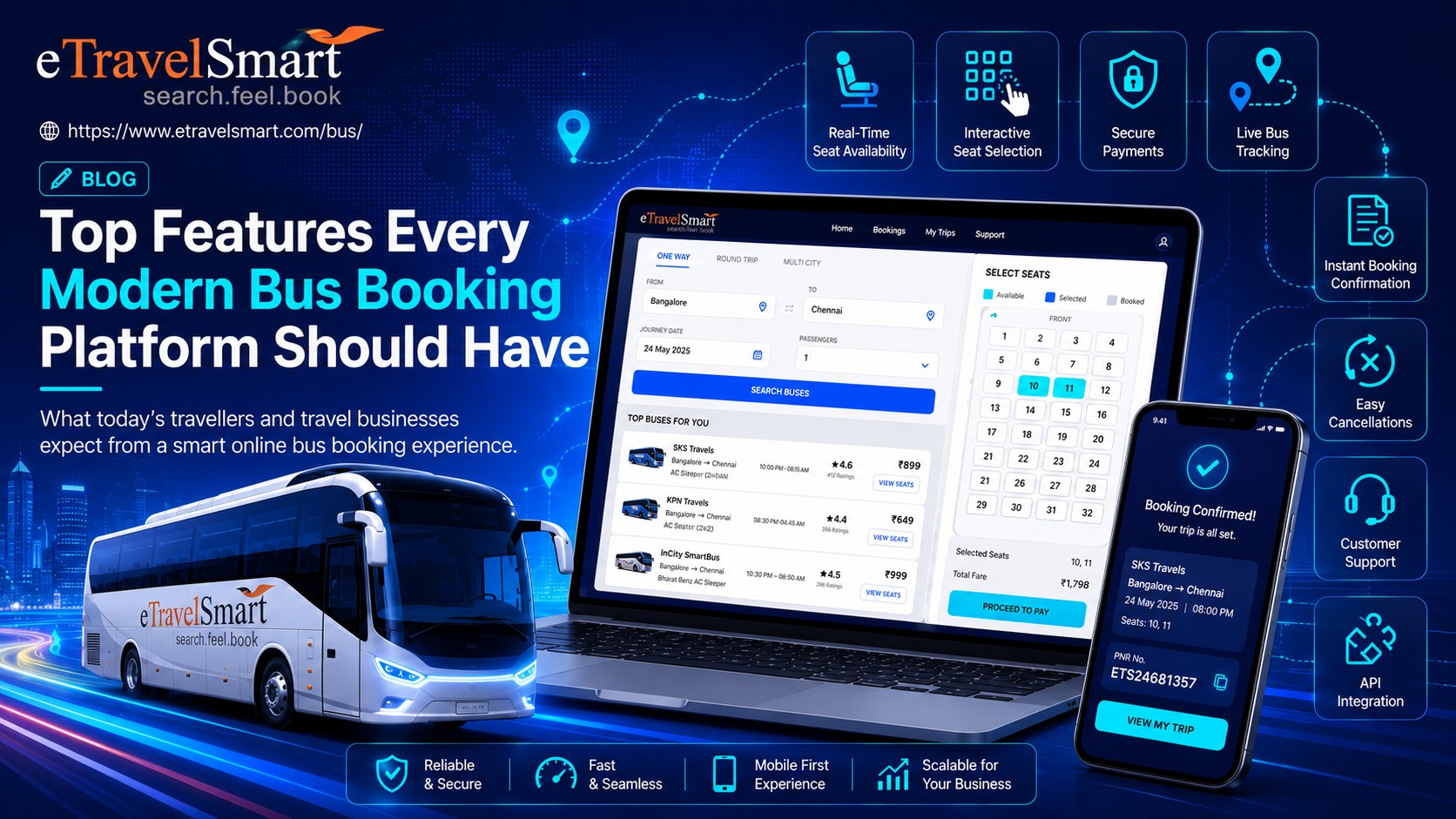
20 Must Have Features of a Modern Bus Booking Platform

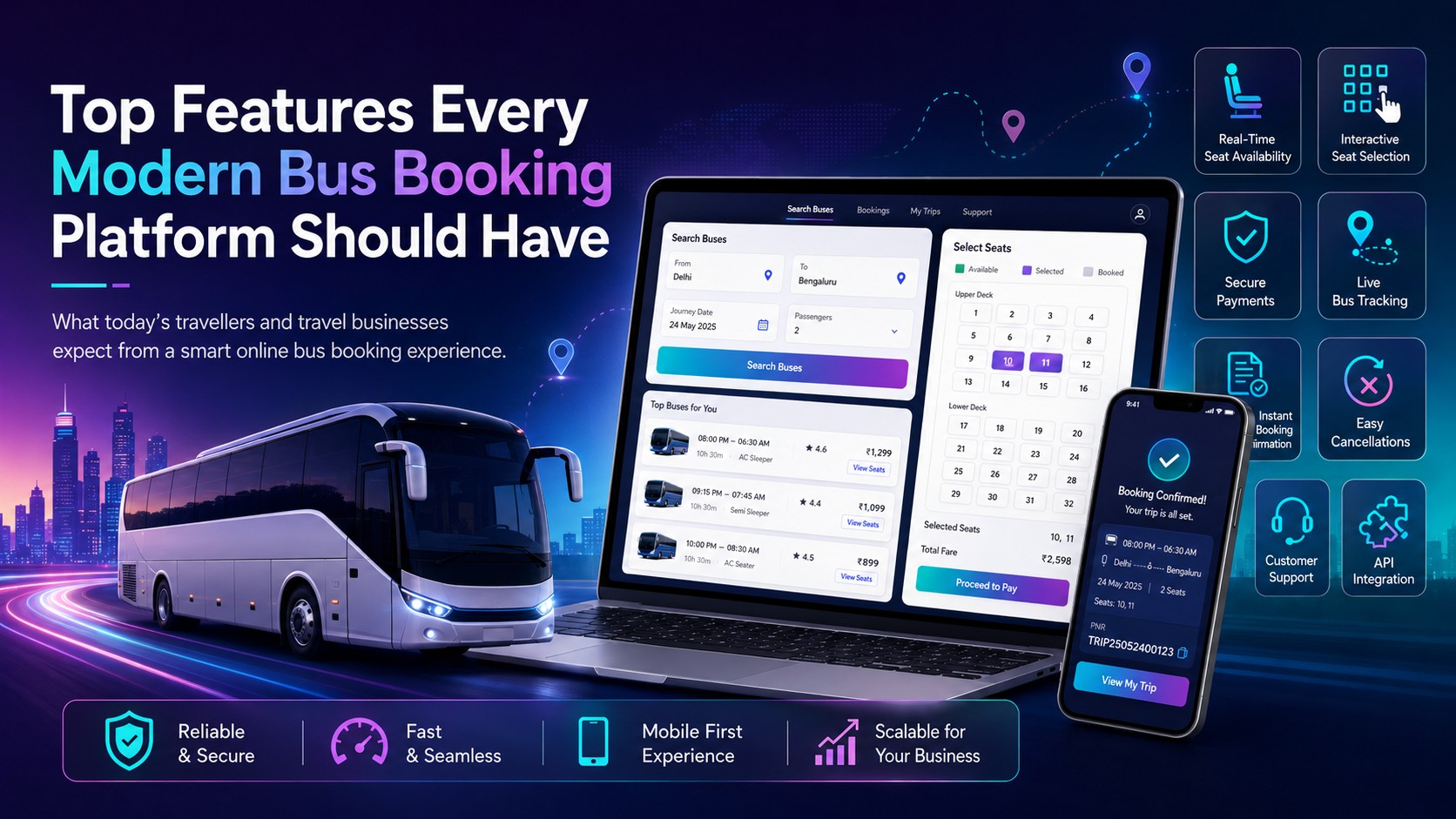
Top features every Modern Bus Booking Platform should have

Booking a bus ticket should not feel like solving a puzzle. Discover the essential features every modern bus booking platform needs including live seat availability, secure payments, tracking, APIs, and support.

Why Every Travel Business Needs a Modern Bus Booking Platform

Traveler’s today expect to search for buses, compare options, select seats, make payments, and receive confirmation within a few minutes. They do not want to visit multiple websites, make repeated phone calls, or wait at a bus counter to know whether seats are available. For bus operators, travel agents, online travel portals, and mobility businesses, this shift has created a clear opportunity. A modern bus booking platform is no longer just a website that sells tickets. It is a complete travel technology solution that connects passengers, operators, agents, payment systems, and support teams.

Top features every Modern Bus Booking Platform should have

Top Features of a Modern Bus Booking Platform

Not every Modern Bus Booking Platform offers the same level of convenience and reliability. While the best platforms provide a fast, secure, and seamless booking experience, others lose potential customers due to slow search results, outdated seat availability, confusing interfaces, payment failures, or inadequate customer support. Choosing the right Modern Bus Booking Platform can significantly improve customer satisfaction, increase booking conversions, and build long-term trust. Let’s explore the essential features every Modern Bus Booking Platform should include.

Here are the most important features every modern bus booking platform should have.

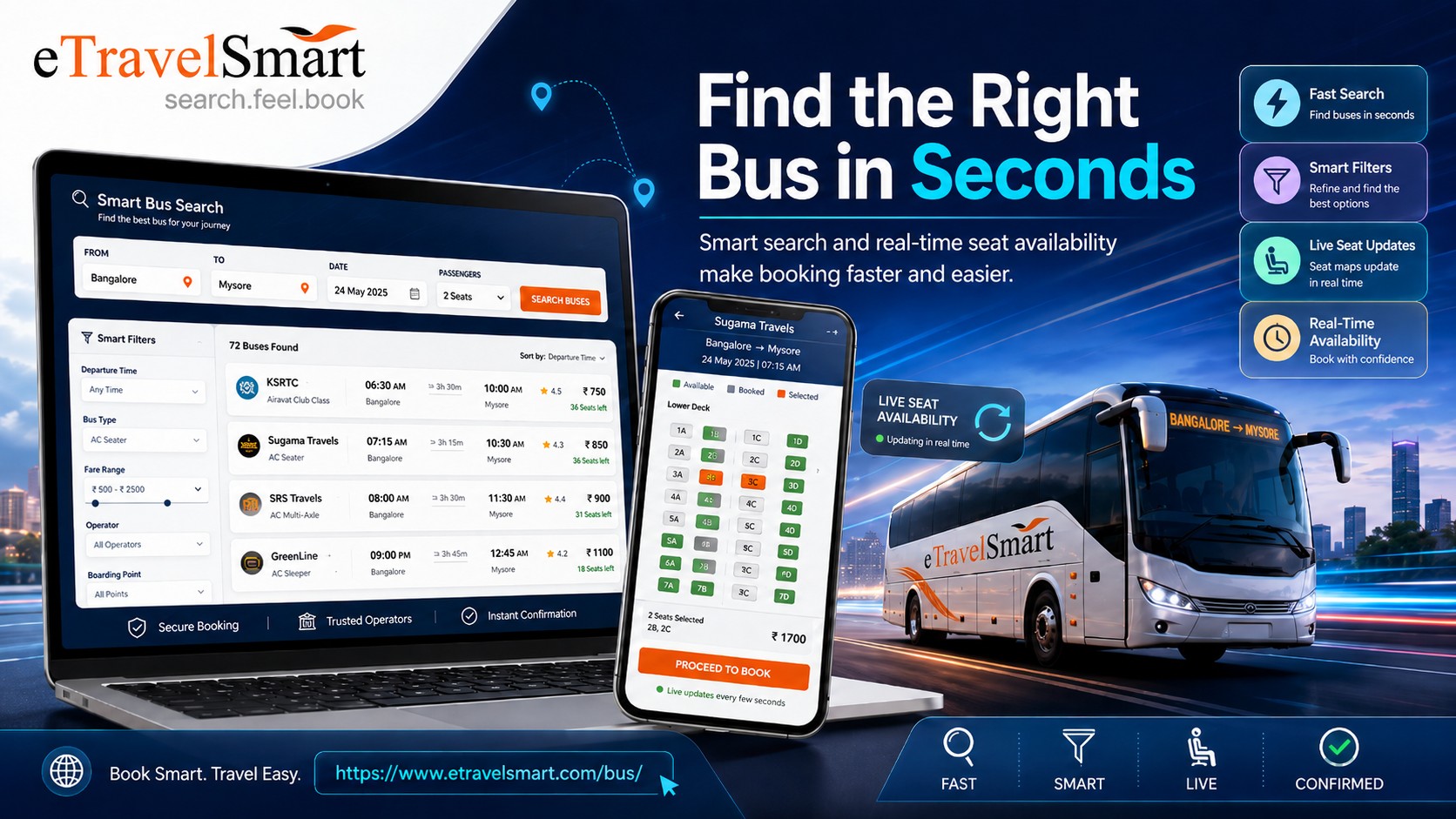
1. Fast and Intelligent Bus Search

The search function is the starting point of every booking journey.
Passengers should be able to enter their:

  • Boarding city
  • Destination city
  • Travel date
  • Number of passengers

The platform should then quickly display all available buses for the selected route.
A Modern Bus Booking Platform should do more than simply display a long list of buses. It should help passengers quickly find the most suitable travel option using intelligent search filters such as departure time, arrival time, bus type, boarding and dropping points, ticket price, operator name, seat availability, passenger ratings, and onboard amenities. This improves the booking experience and helps users make faster, more informed decisions.

  • Departure time
  • Arrival time
  • Bus type
  • Boarding point
  • Dropping point
  • Ticket price
  • Operator name
  • Seat availability
  • Passenger ratings

For example, a passenger looking for an overnight sleeper bus should be able to filter out daytime and seater buses immediately.
Faster and more accurate search results reduce frustration and increase the chances of completing a booking.

Find the right bus in seconds

2. Real Time Seat Availability

One of the most important features of a bus booking platform is live seat availability.
Passengers should be able to see which seats are:

  • Available
  • Already booked
  • Temporarily blocked
  • Reserved for women
  • Reserved for specific passenger categories

Real-time updates help prevent situations where two passengers attempt to book the same seat.

The availability information must be connected directly with the bus operator’s inventory system. Whenever a seat is booked, cancelled, blocked, or released, the platform should update the status automatically.

Accurate seat availability builds trust and reduces booking disputes.

3. Interactive Seat Selection

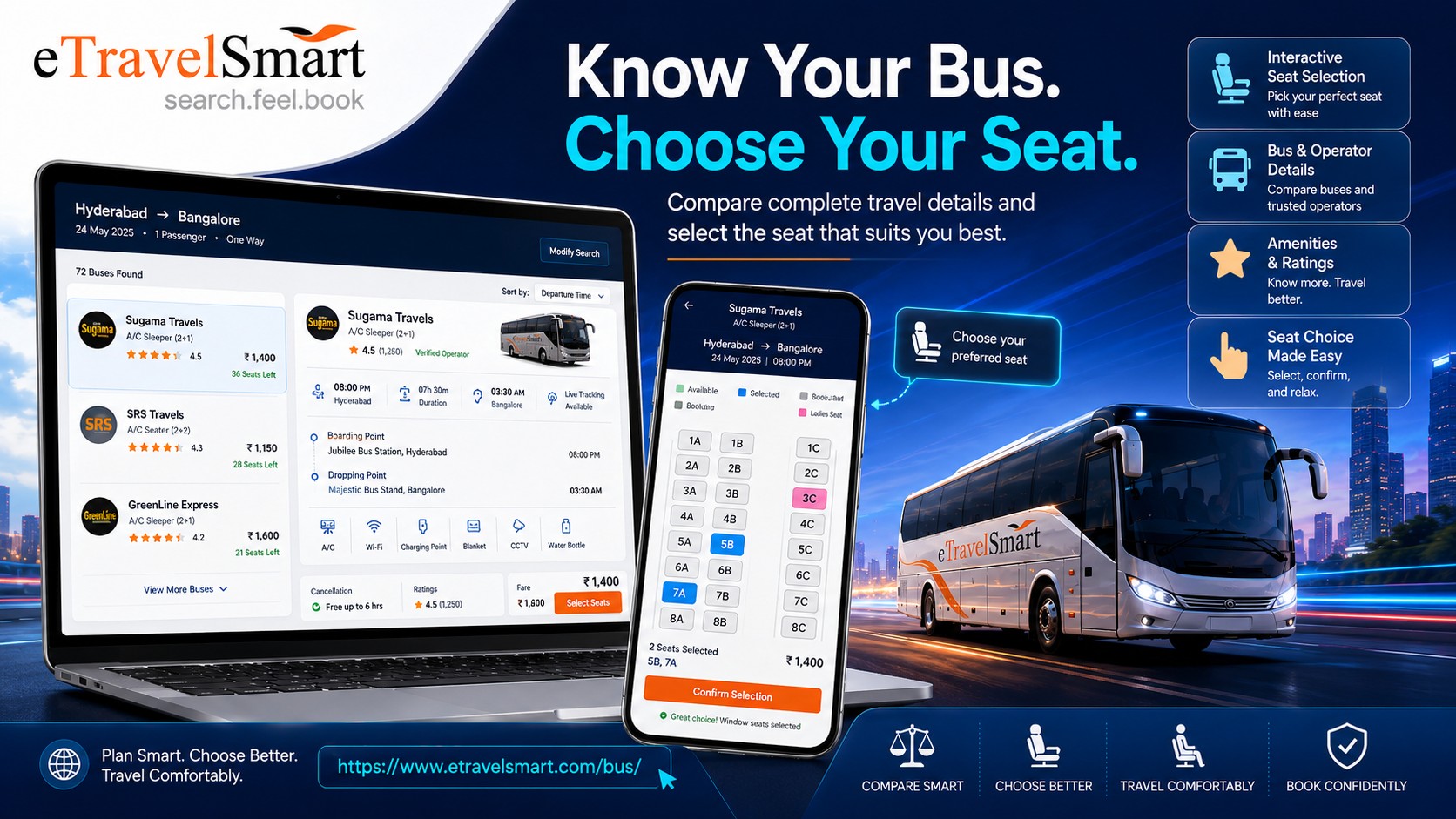
One of the key features of a Modern Bus Booking Platform is interactive seat selection. Today’s passengers prefer choosing their own seats instead of having them assigned automatically. A Modern Bus Booking Platform should provide a clear, user-friendly, and interactive seat map that allows travelers to view the complete bus layout before booking. This helps passengers select seats based on their comfort, travel preferences, and availability, making the booking process more convenient and transparent. The seat map should clearly display:

  • Lower and upper berths
  • Window and aisle seats
  • Single and double sleepers
  • Driver position
  • Entry and exit points
  • Available and occupied seats
  • Seat-specific pricing

The seat layout should work smoothly on both desktop and mobile devices.
Whether it’s a family looking for seats together or a solo traveler preferring a single berth, a Modern Bus Booking Platform should make seat selection simple and flexible. An interactive seat map gives passengers greater control over their journey, enhances booking confidence, and delivers a more personalized travel experience.

Know your bus. choose your seat

4. Complete Bus and Operator Information

Passengers want to know what they are booking before making a payment.
Each bus listing should provide important details such as:

  • Bus operator name
  • Bus type
  • Departure and arrival time
  • Total journey duration
  • Boarding and dropping points
  • Available amenities
  • Cancellation policy
  • Luggage rules
  • Passenger ratings
  • Bus photos, when available

Amenities may include:

  • Air conditioning
  • Charging points
  • Blankets
  • Water bottles
  • Reading lights
  • Wi-Fi
  • Entertainment systems
  • Emergency exits
  • Live tracking

Providing transparent information helps passengers compare options and make confident decisions.

5. Multiple Boarding and Dropping Points

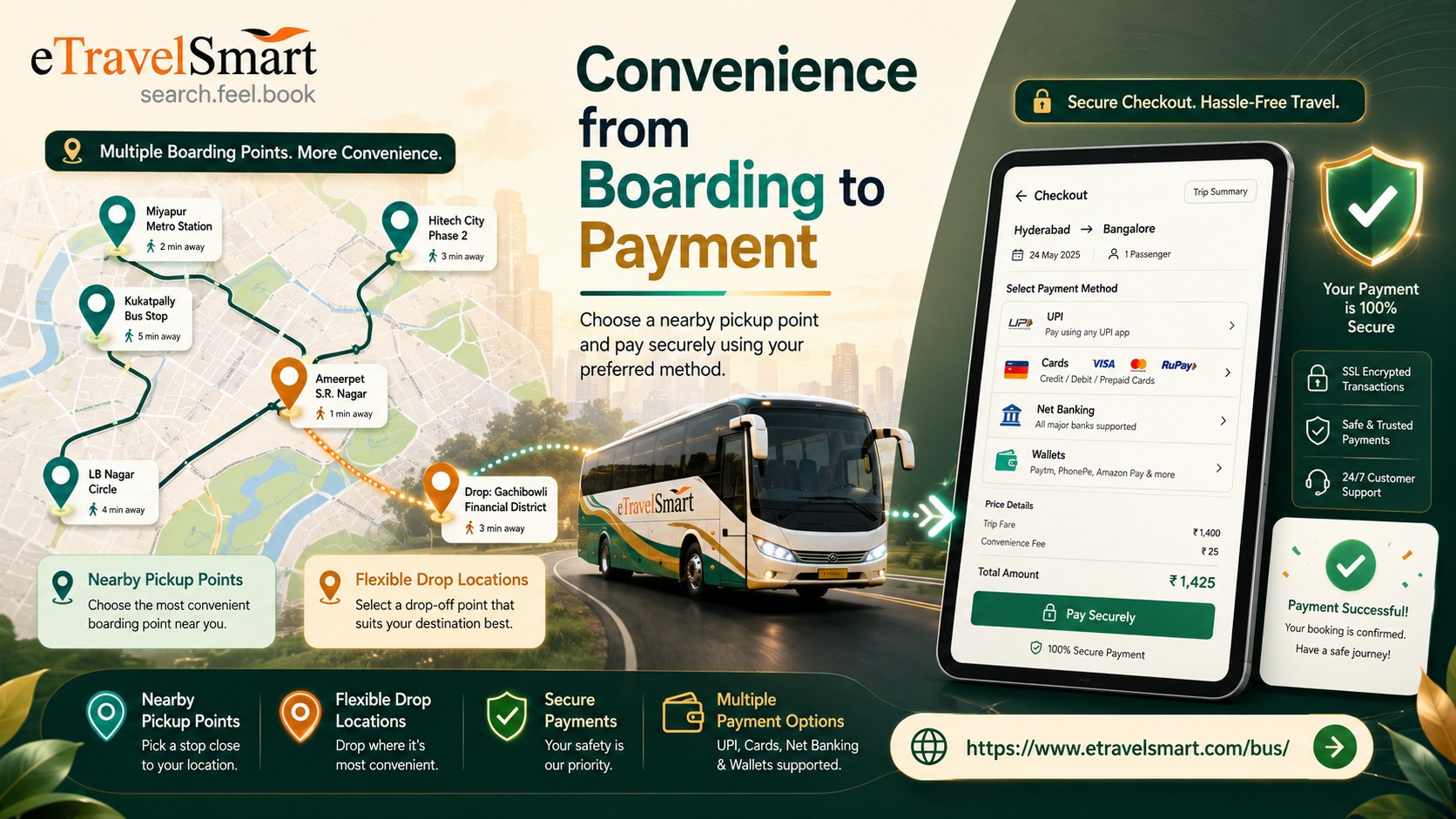
A Modern Bus Booking Platform should make boarding and drop-off selection simple and convenient. In large cities with multiple pickup and drop-off locations, passengers may not want to travel across the city just to catch their bus. By allowing users to choose their preferred boarding and dropping points during the booking process, a Modern Bus Booking Platform enhances convenience, saves travel time, and improves the overall passenger experience.

Each location should include:

  • Exact address
  • Landmark
  • Reporting time
  • Contact information
  • Map location
  • Pickup instructions

This feature becomes especially valuable in metropolitan cities where reaching the wrong boarding point can result in a missed bus.

Convenience from boarding to payment

6. Secure and Flexible Payment Options

A passenger may find the right bus and preferred seat but still abandon the booking if the payment process is difficult.A modern platform should support multiple payment methods, including:

  • UPI
  • Debit cards
  • Credit cards
  • Net banking
  • Mobile wallets
  • Payment links
  • International cards, where applicable

A Modern Bus Booking Platform should offer a secure, reliable, and user-friendly payment gateway that supports multiple payment methods for a hassle-free checkout experience. It should also handle payment failures efficiently by providing clear updates if a transaction is unsuccessful or if money is deducted without a confirmed booking. Transparent communication about booking status and refund timelines builds customer trust, while a smooth and secure checkout process helps increase successful bookings and reduce cart abandonment.

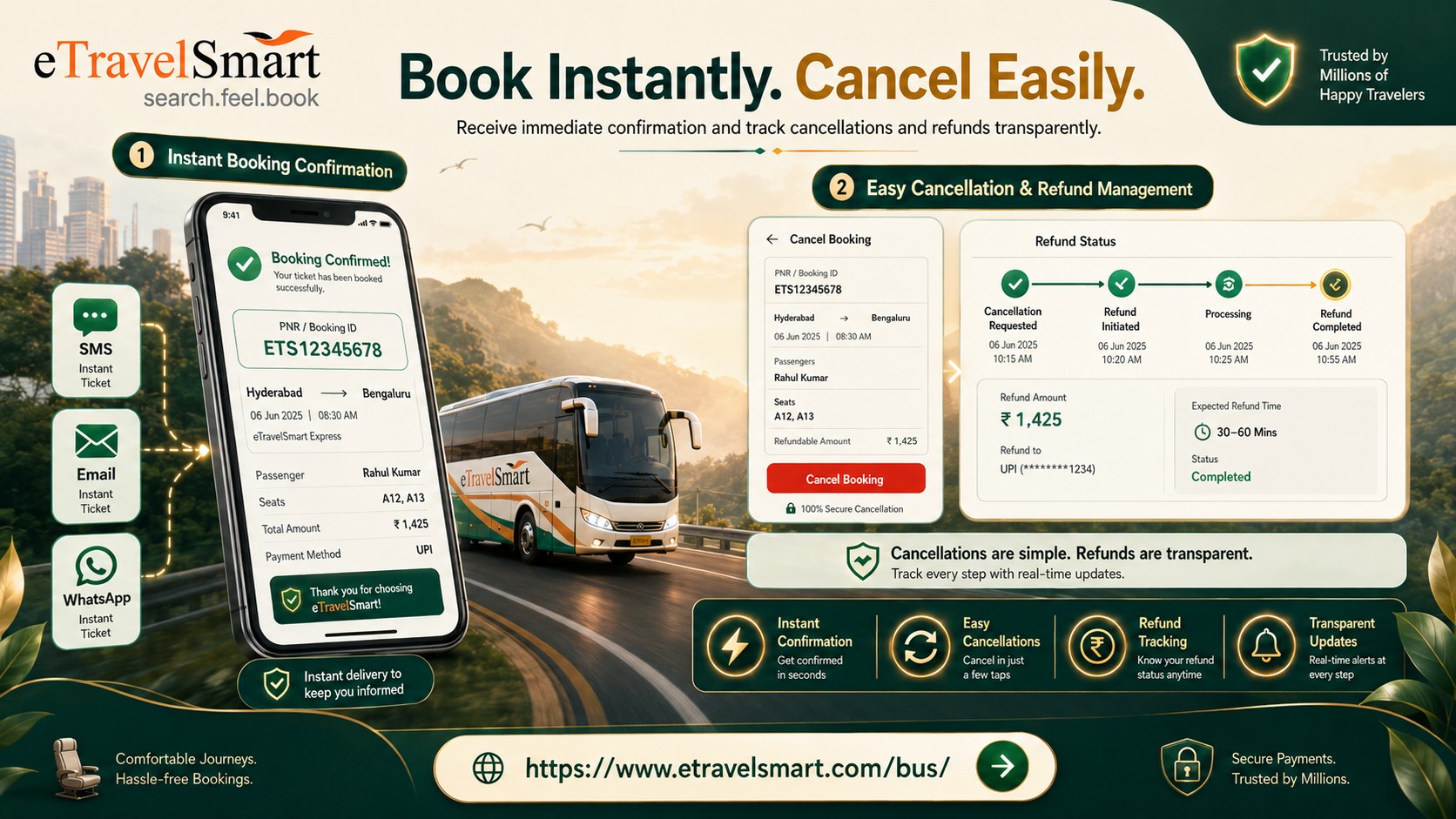
7. Instant Booking Confirmation

Passengers should receive confirmation immediately after a successful payment.The confirmation should be delivered through channels such as:

  • SMS
  • Email
  • WhatsApp
  • Mobile app notification

The ticket should clearly display:

  • Booking ID or PNR
  • Passenger name
  • Operator details
  • Bus number, when available
  • Seat number
  • Travel date
  • Boarding point
  • Boarding time
  • Dropping point
  • Customer support contact

Passengers should also be able to download or access their ticket later without searching through old messages.

Book Instantly. Cancel easily.

8. Easy Cancellation and Refund Management

Travel plans can change unexpectedly. A modern booking platform should make cancellation simple and transparent.Before booking, passengers should be able to view:

  • Cancellation charges
  • Refund eligibility
  • Time-based deduction rules
  • Non-refundable conditions
  • Expected refund timeline

After cancellation, the platform should provide real-time updates on the refund status.A clear refund process protects the platform’s reputation and reduces the number of support calls.

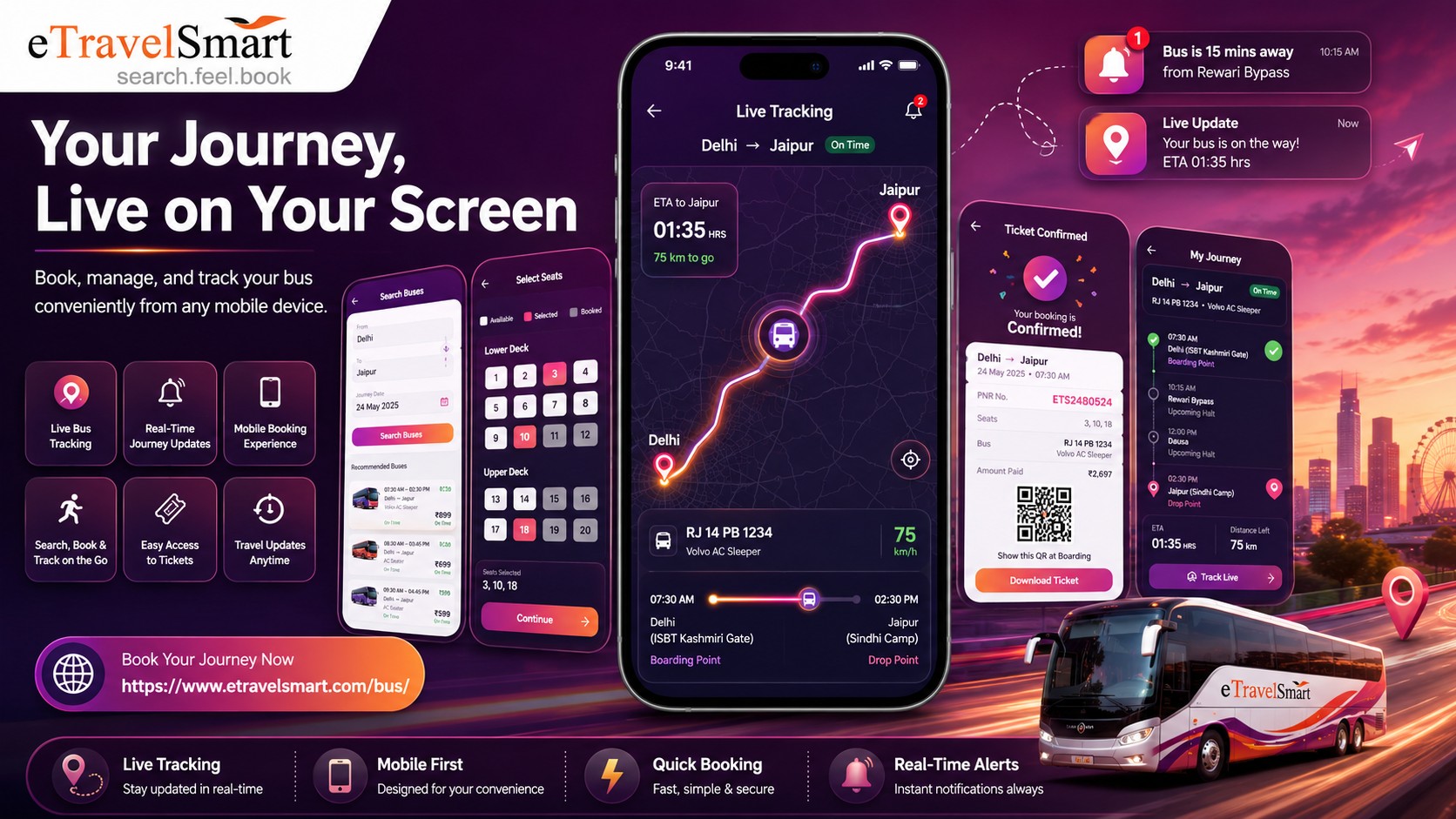
9. Live Bus Tracking

Live tracking has become one of the most valuable features in modern bus travel.Passengers should be able to check:

  • Current bus location
  • Estimated arrival time
  • Possible delays
  • Distance from the boarding point
  • Updated journey progress

Live tracking is an essential feature of a Modern Bus Booking Platform. It keeps passengers informed about delays caused by traffic, weather conditions, road diversions, or operational issues by providing real-time journey updates. A Modern Bus Booking Platform also allows family members to track the bus location, offering greater peace of mind, improved safety, and a more reliable travel experience for everyone.

Accurate pickup and drop locations can be enhanced using Google Maps Platform for navigation and location services.

Your journey, live on your screen

10. Mobile Friendly Booking Experience

A large number of travellers search for and book tickets using smartphones.Therefore, every bus booking platform should be fully mobile-responsive. Users should not need to zoom, scroll sideways, or struggle with small buttons.

The mobile booking process should be:

  • Fast
  • Simple
  • Touch-friendly
  • Secure
  • Easy to navigate

A Modern Bus Booking Platform should deliver a seamless experience across all devices, ensuring that essential actions such as searching for buses, selecting seats, entering passenger details, making secure payments, downloading tickets, and cancelling bookings work smoothly on every screen size. While a dedicated mobile app offers added convenience through features like push notifications and faster access, a responsive and well-optimized mobile website remains essential for providing a hassle-free booking experience to all users.

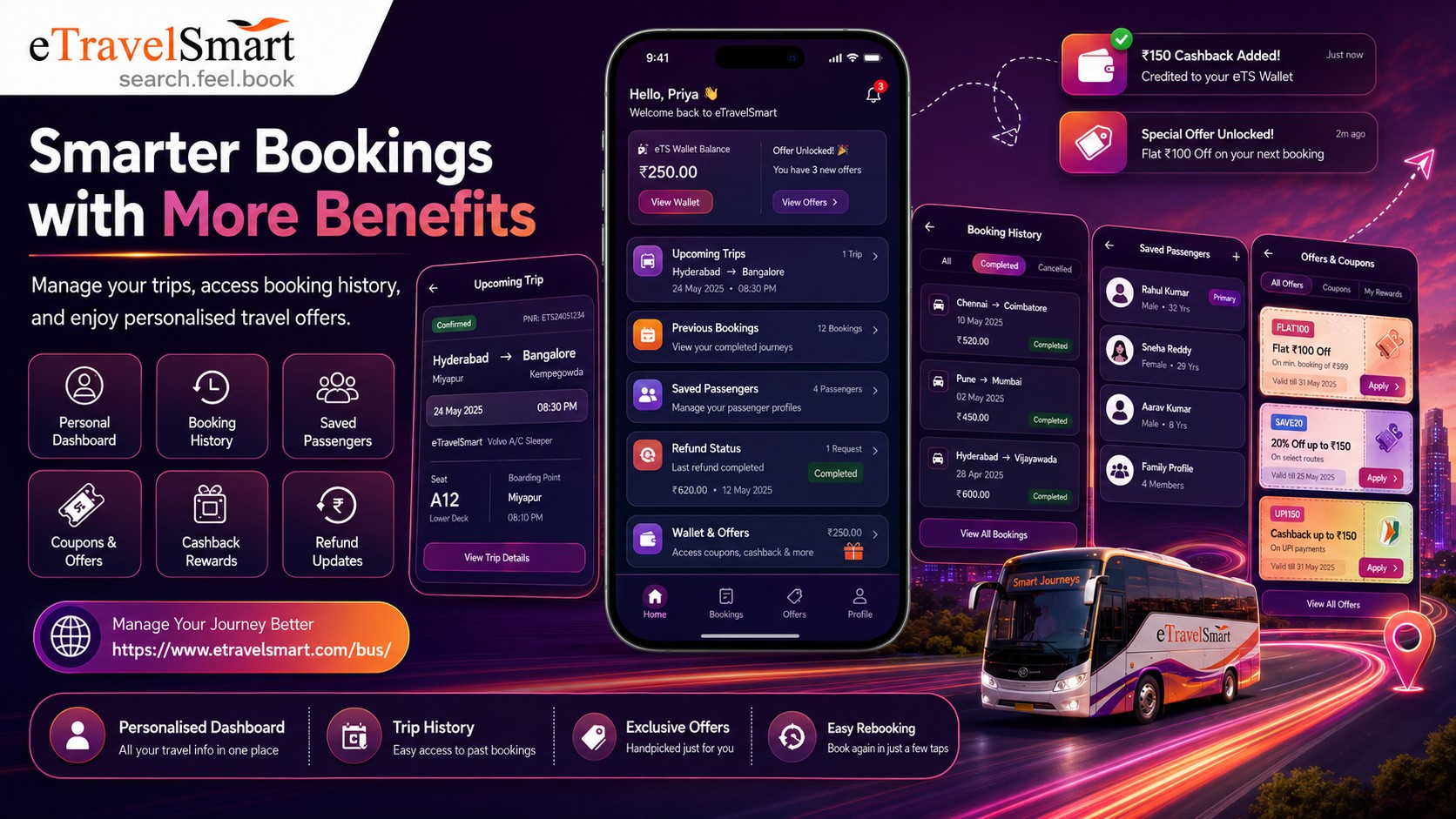
11. User Accounts and Booking History

Passengers should be able to create an account and manage their bookings from a personal dashboard.
A useful customer dashboard may include:

  • Upcoming journeys
  • Previous bookings
  • Cancelled tickets
  • Refund status
  • Saved passengers
  • Preferred routes
  • Downloadable invoices
  • Special offers
  • Wallet balance or reward points

At the same time, platforms should also allow guest booking for users who do not want to create an account.
Providing both options creates a balance between speed and personalisation.

Smarter bookings with more benefits

12. Offers, Discounts and Coupon Management

Offers can encourage first-time users to complete a booking and motivate existing customers to return.

A modern platform should support:

  • First-booking discounts
  • Route-based promotions
  • Operator-specific offers
  • Seasonal campaigns
  • Referral rewards
  • Cashback promotions
  • Agent-specific discounts
  • Coupon codes

A Modern Bus Booking Platform should clearly display offer terms and automatically apply eligible discounts whenever possible. Transparent pricing and easy-to-understand promotions help passengers book with confidence, while misleading or complicated offers can reduce trust and increase booking abandonment.

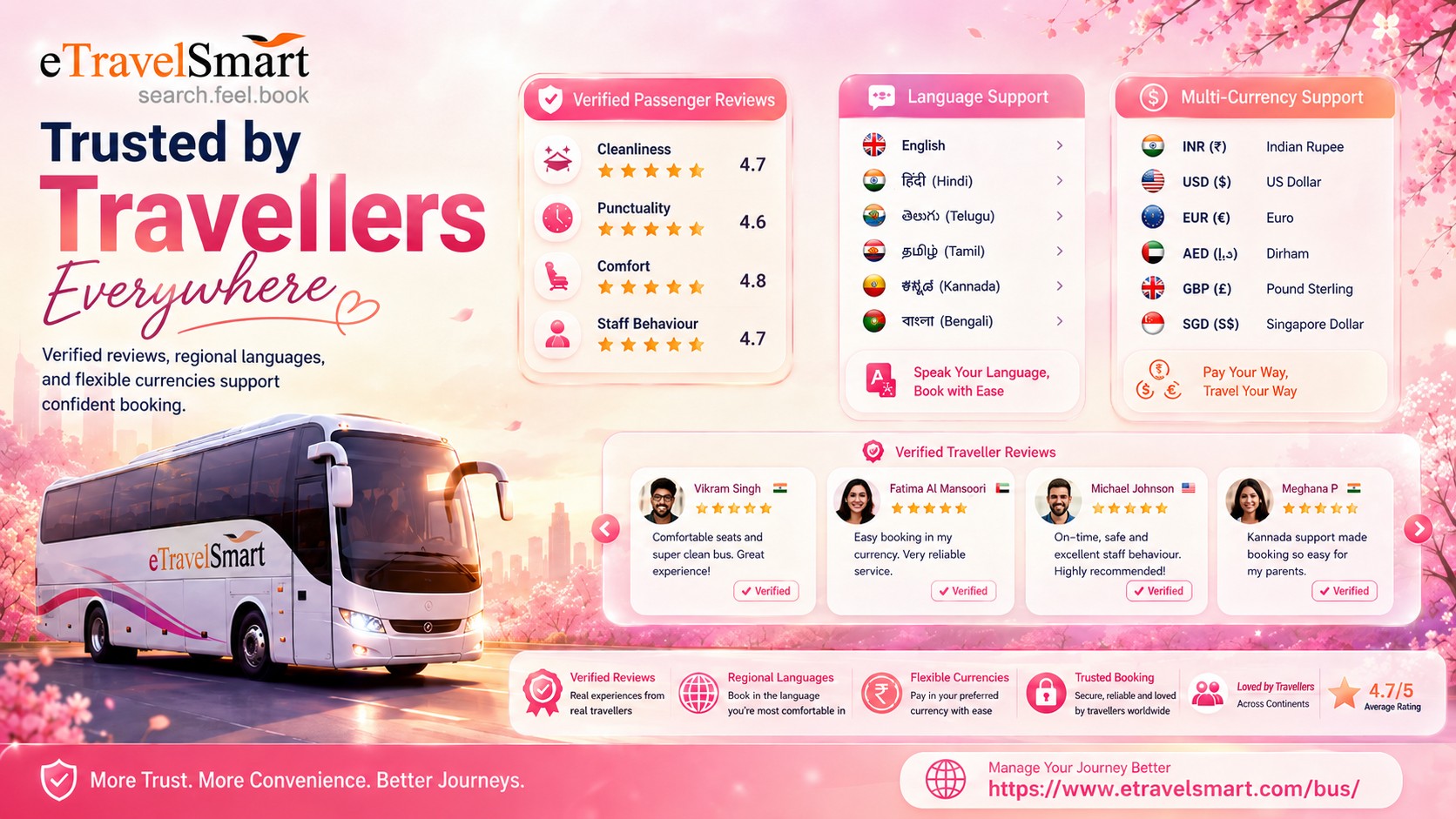
13. Ratings and Passenger Reviews

Reviews help travellers make better decisions, especially when several operators serve the same route.
Passengers should be able to rate areas such as:

  • Bus cleanliness
  • Staff behaviour
  • Punctuality
  • Driving quality
  • Seat comfort
  • Boarding experience
  • Overall journey satisfaction

Only verified passengers should ideally be allowed to submit reviews. This improves credibility and helps operators identify areas where they need to improve.

Trusted by travelers everywhere

14. Multilingual and Multi Currency Support

A Modern Bus Booking Platform should cater to passengers from different regions, languages, and cultural backgrounds by offering a seamless and inclusive booking experience. Multilingual support allows users to browse and book tickets in their preferred language, making the platform more accessible for those who are not comfortable with English. For businesses serving international travelers, multi-currency support enables passengers to view fares and make payments in their preferred currency. These features enhance user convenience, expand market reach, and help a Modern Bus Booking Platform attract a broader customer base.

15. Reliable Customer Support

Even the best booking system cannot prevent every travel or payment issue.Passengers may need assistance with:

  • Failed bookings
  • Payment deductions
  • Seat changes
  • Bus delays
  • Boarding point confusion
  • Cancellations
  • Refunds
  • Lost tickets
  • Operator communication

A Modern Bus Booking Platform should provide reliable customer support through multiple channels, such as:

  • Phone
  • Email
  • Live chat
  • WhatsApp
  • Help centre
  • Chatbot

The support team should also have access to booking, payment, and operator information so that issues can be resolved quickly.

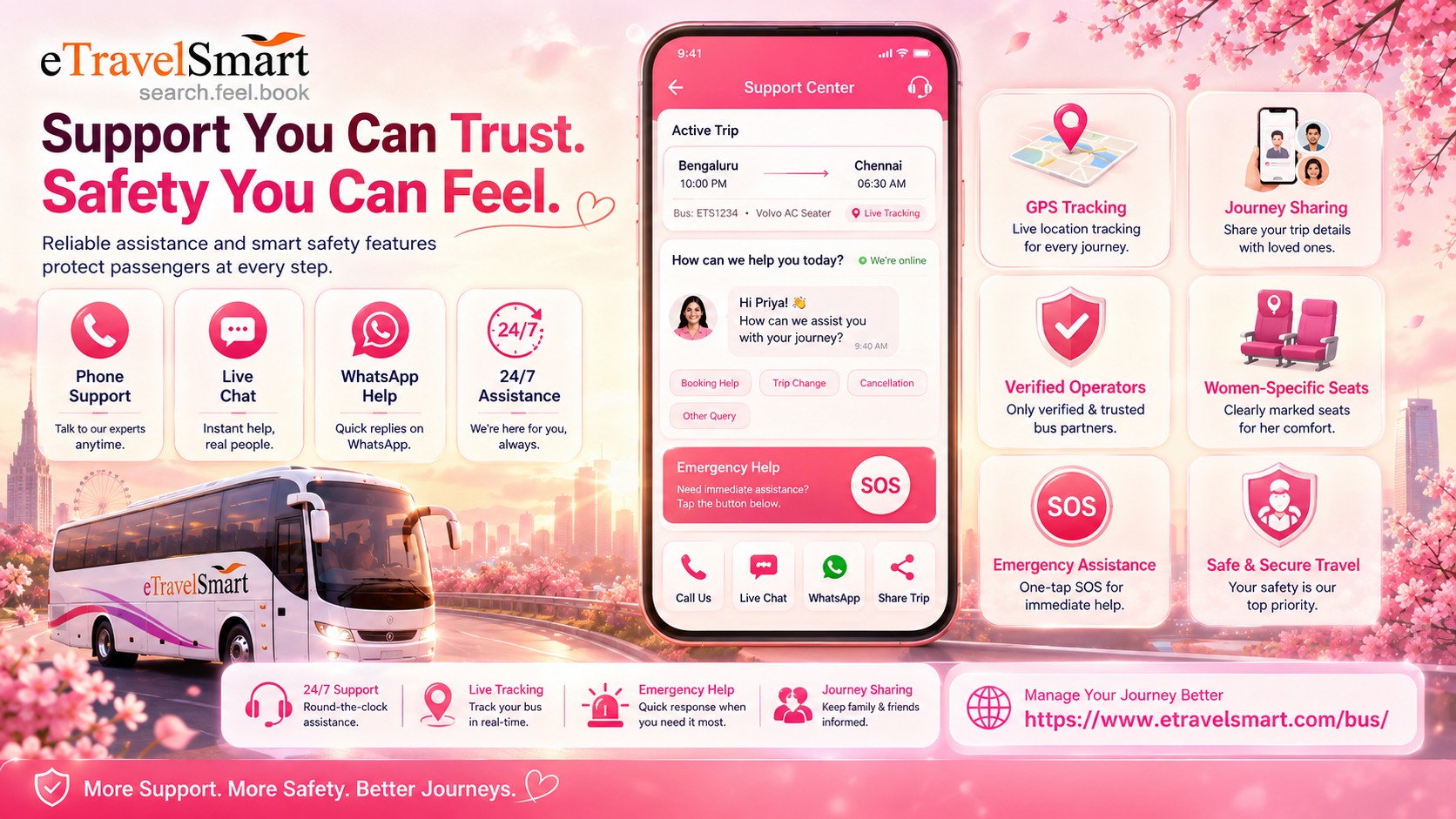
Support you can trust. Safety you can feel.

16. Passenger Safety Features

Safety should be treated as a core platform feature rather than an optional addition.Useful safety features may include:

  • Verified operator profiles
  • Driver and vehicle information
  • Emergency contact options
  • Live journey sharing
  • GPS tracking
  • Women-specific seat indicators
  • Vehicle compliance details
  • Incident reporting
  • Secure passenger data handling

Displaying clear safety information can improve passenger confidence, particularly for solo travellers, women, senior citizens, and families.

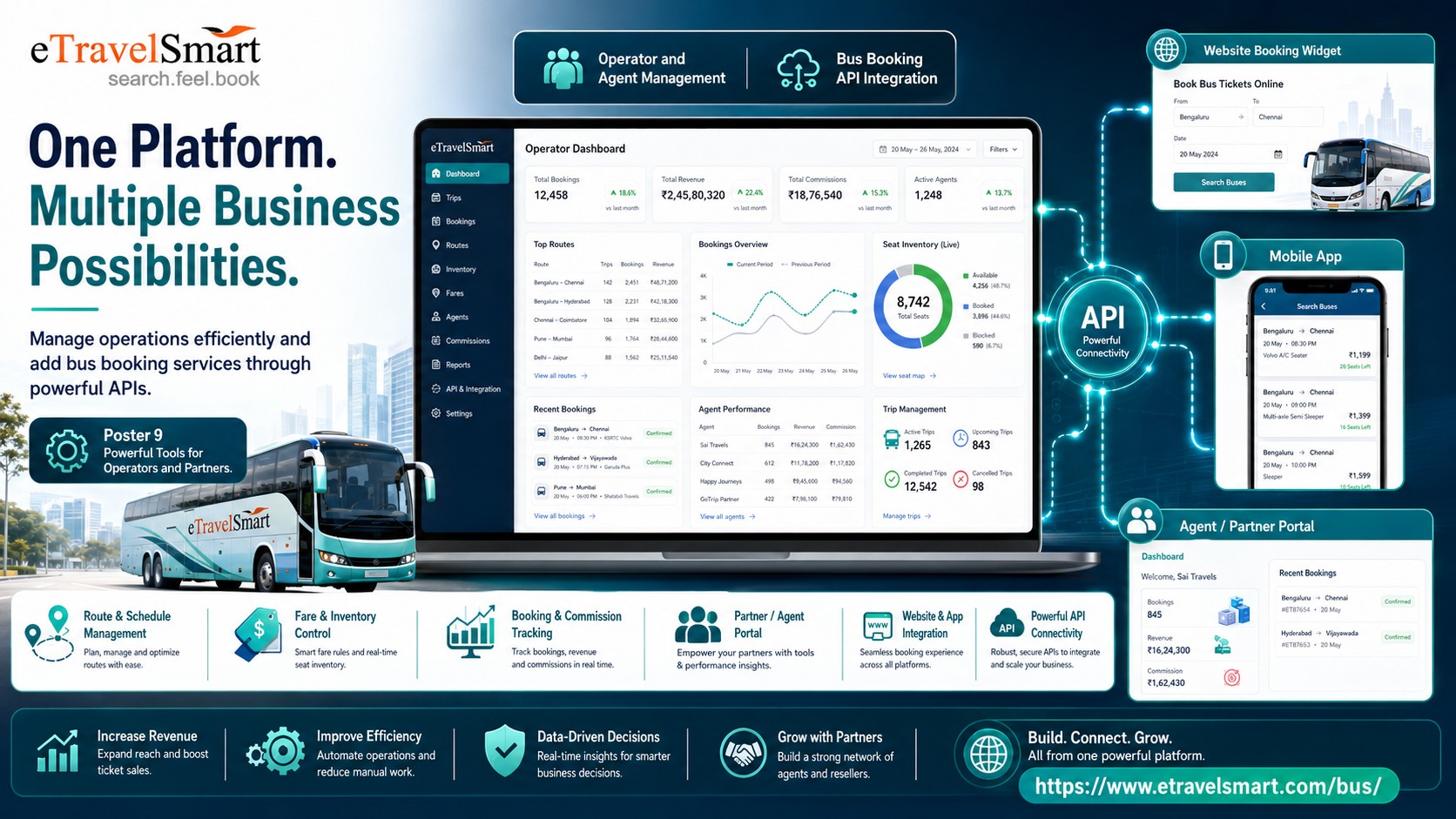
17. Operator and Agent Management

A bus booking platform must work efficiently not only for passengers but also for operators and agents.Operators should be able to manage:

  • Bus schedules
  • Routes
  • Seat layouts
  • Boarding points
  • Ticket prices
  • Offers
  • Bookings
  • Cancellations
  • Passenger lists
  • Trip reports

Travel agents should be able to search buses, book seats, manage customers, track commissions, print tickets, and review transaction history.

A well designed backend reduces manual work and helps the business scale efficiently.

One platform. Multiple Business Possibilities.

18. Bus Booking API Integration

Businesses may want to offer bus tickets through their existing website, mobile application, corporate travel portal, or agent network.

A bus booking API can provide access to features such as:

  • Bus search
  • Real-time seat availability
  • Seat layout
  • Fare details
  • Seat blocking
  • Booking confirmation
  • Cancellation
  • Refund status
  • Ticket retrieval

API integration helps travel companies launch bus booking services without building the complete operator network and reservation infrastructure from the beginning.

It also allows businesses to offer more routes and operators through a single connection.

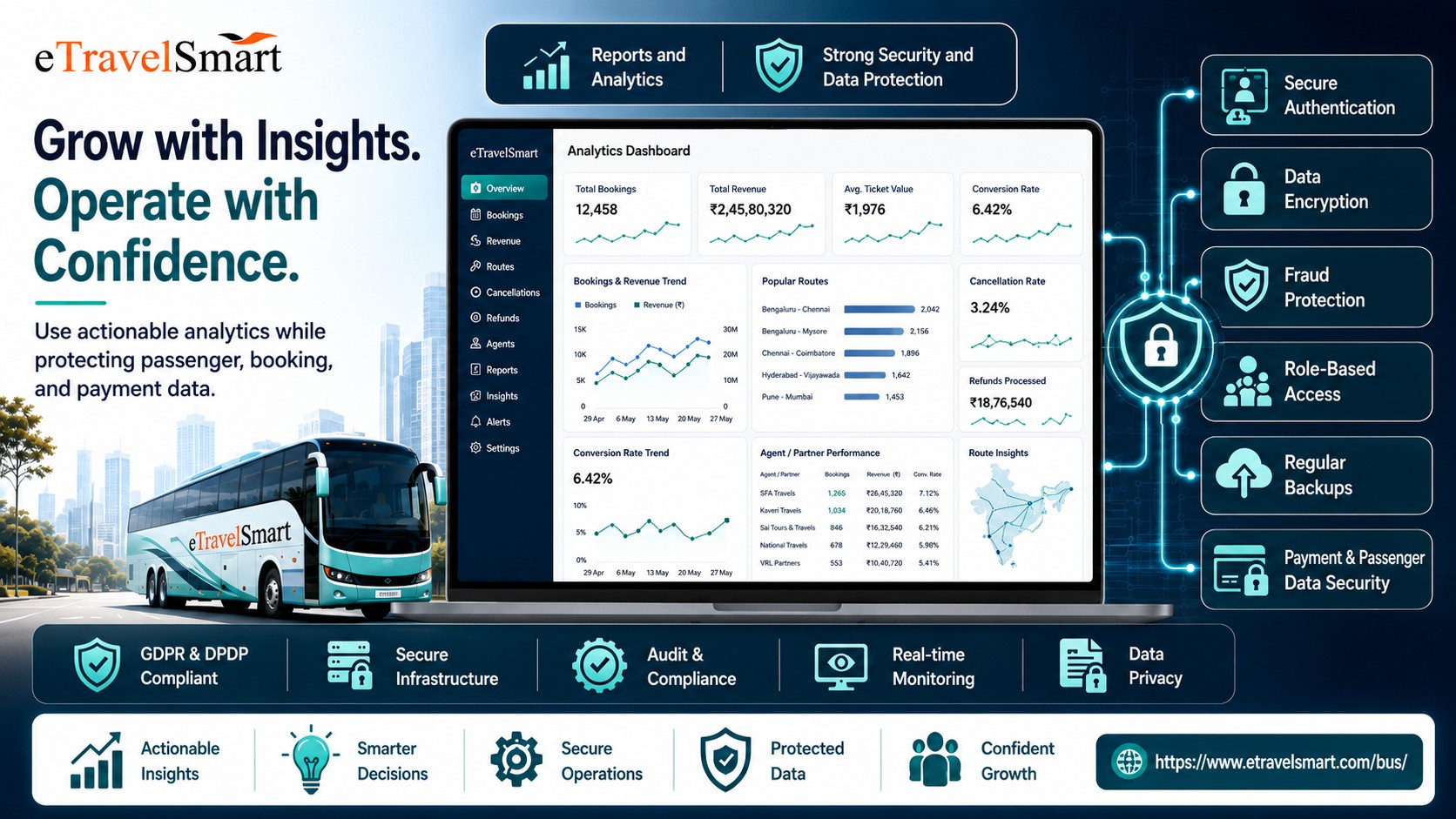
19. Reports and Analytics

Data helps booking platforms understand what is working and where improvement is needed.A modern reporting dashboard should provide information about:

  • Total bookings
  • Revenue
  • Popular routes
  • Most-booked operators
  • Booking conversion rate
  • Cancellation rate
  • Payment failures
  • Refunds
  • Agent performance
  • Customer behaviour
  • Peak travel periods

These insights help businesses improve pricing, marketing, route selection, customer support, and operational planning.

Grow with insights. Operate with confidence.

20. Strong Security and Data Protection

A bus booking platform handles sensitive information such as passenger names, phone numbers, travel details, and payment transactions.

The platform must use strong security practices, including:

  • Secure user authentication
  • Encrypted data transmission
  • Payment gateway security
  • Role-based access
  • Fraud detection
  • Activity logs
  • Regular backups
  • Secure API authentication
  • Protection against automated attacks

Customers may not always notice the security systems working behind the scenes, but these systems are essential for maintaining trust.

What Makes a Bus Booking Platform Truly Modern?

A Modern Bus Booking Platform is defined not just by its features, but by how seamlessly those features work together.

A passenger should be able to:

  1. Search for buses quickly.
  2. Compare suitable options.
  3. Select a preferred seat.
  4. Choose a convenient boarding point.
  5. Complete payment securely.
  6. Receive instant confirmation.
  7. Track the bus.
  8. Get support when required.

At the same time, operators, agents, and platform administrators should have the tools required to manage bookings, inventory, pricing, payments, customers, and reports efficiently.

How eTravelSmart Supports Modern Bus Booking Businesses

eTravelSmart provides Modern Bus Booking Platform solutions for businesses looking to enter or expand in the online bus booking industry. Through advanced bus booking software and API integration, travel companies can offer passengers seamless access to bus search, schedules, real-time seat availability, interactive seat selection, secure booking, ticket cancellation, and other essential travel services directly through their own websites and mobile applications.

Whether you operate a travel portal, mobile application, agency network, corporate travel service, or online marketplace, a Modern Bus Booking Platform can help you deliver a faster, more reliable, and seamless booking experience while improving customer satisfaction and business growth.

Frequently Asked Questions

1. What is a modern bus booking platform?

A modern bus booking platform is a digital system that allows passengers to search for buses, compare fares and timings, select seats, make payments, receive tickets, cancel bookings, and track their journey online.It can also provide operators, agents, and administrators with tools to manage routes, schedules, seat inventory, pricing, bookings, payments, cancellations, and reports.

2. Why is real time seat availability important in bus booking?

Real-time seat availability helps passengers see the latest status of every seat before making a booking. It reduces the risk of duplicate bookings and prevents customers from selecting seats that have already been reserved.The seat inventory should update automatically whenever a seat is booked, blocked, cancelled, or released.

3. What payment options should a bus booking platform support?

A bus booking platform should support commonly used payment methods such as UPI, debit cards, credit cards, net banking, mobile wallets, and secure payment links.It should also handle unsuccessful transactions properly and provide clear updates when money is deducted but the booking is not confirmed.

4. How does a bus booking API help travel businesses?

A bus booking API allows travel businesses to add bus ticketing services to their existing website, mobile application, agent portal, or corporate travel platform.Through one integration, businesses can access bus search, schedules, seat layouts, live availability, fares, booking, cancellation, and ticket details without building the complete reservation infrastructure from the beginning.

5. Can eTravelSmart support travel agents and bus operators?0

Yes. eTravelSmart provides technology solutions that can help travel agents, online travel portals, operators, corporate travel providers, and other travel businesses offer bus booking services.

The platform can support essential functions such as bus search, seat availability, seat selection, booking confirmation, cancellation, API integration, and booking management.

Conclusion

Passengers no longer compare bus booking platforms only by ticket price. They also consider speed, convenience, transparency, payment security, support, and overall experience.Features such as real time seat availability, interactive seat selection, live tracking, flexible payments, instant confirmation, simple cancellations, customer support, and API connectivity have become essential.For travel businesses, investing in a modern bus booking platform is not just about selling more tickets. It is about building customer trust, reducing manual operations, improving service quality, and creating a scalable digital travel business.With the right platform and technology partner, every stage of the bus booking journey can become simpler for passengers, agents, operators, and travel businesses alike.

🌐 Website: https://www.etravelsmart.com/
📞 Customer Support: +91 8885255344